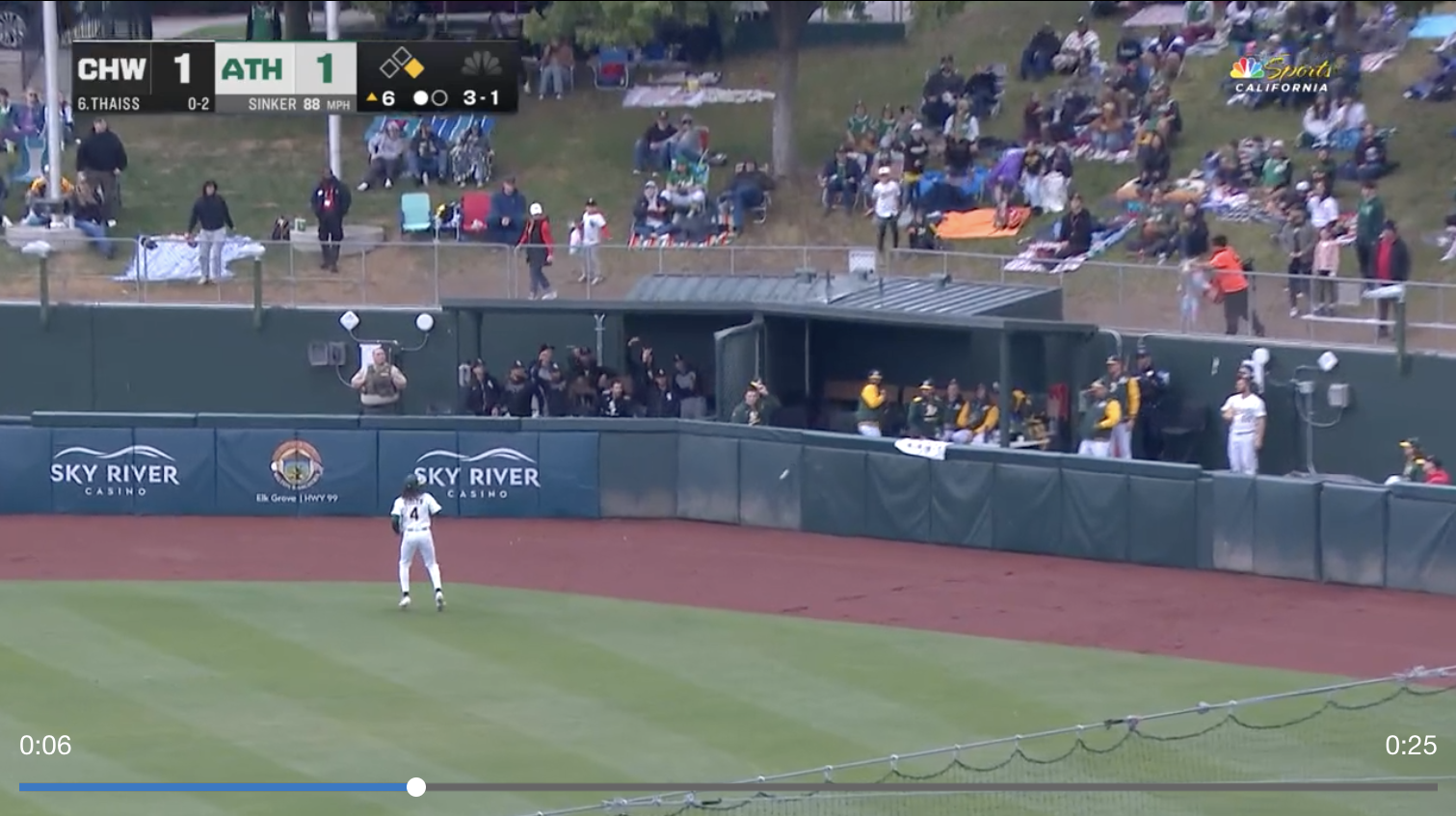
Lawrence Butler of the Sacramento Athletics watches as a ball rebounds off the outfield wall at Sutter Health Park in Sacramento.
A Fly Ball Falls In Safe
The batter hits a fly ball into the outfield, the fielders track it... but when all is said and done, the ball winds up falling to the grass/turf/dirt without being touched by a fielder. The batter is going to be safe, it’s just a question of how many bases they’re going to wind up with.
The vast majority of fly balls in the outfield will wind up being caught, just for the simple fact that they hang up in the air for a while, and that makes it much easier for an outfielder to be there when the ball lands. But even the best outfielders can’t be everywhere, and balls can find holes in defensive positions. Often, this takes the form of a ball that is hit all the way to the wall, but not quite over it. If the outfield is playing shallow, they might not be able to make up the ground in time.
All of this is to say that if a ball is hit in the air, fair, and drops in, the possible results really vary, as the batter can wind up on first base (a single), second base (a double), third base (a triple), or back in the dugout (a home run), with all other baserunners moving up, accordingly. Indeed, if a batter gets a base hit into the outfield, and there are already runners on base, the chances of those runners scoring go up dramatically. There is a bit of baseball lingo that reflects this idea; runners on second or third base are often called being in “scoring position,” on the notion that they will be able to score on an ordinary base hit. But it's certainly not unheard of for a runner on first base to score on an outfield fly ball that falls in.